
My latest native plant giveaway was this cute little Firebush. These things tend to pop up in my yard sporadically throughout the year instead of all at once, so I tend to give them away as they appear, instead of a larger group giveaway.

I’ve got one Firebush in my yard that is quite big… closer to a small tree than a large bush. I suspect he’s the one seeding all the seedlings that I find throughout the yard. I’ve let a few of his offspring prosper, and transplanted a few to other spots in my yard. In total, I’ve probably got about six or seven firebush. I think that’s probably a suitable maximum density for the property. So now whenever I see a seedling sprout up, I yank it out and put it in a pot. When I’m sure that it survived, and it’s big enough to entice a walker-by, of to the swale it goes!

The flowers are beautiful! They are small and narrow, and bloom in bunches. There’s also a variety in the color of the flowers. By biggest specimen has a yellow-orange color, but my second biggest is more of a red. As the giveaway sign says, local insects love it. Ours is often covered with bees and zebra longwing butterflies. And the birds really like the plant’s fruit. One thing I forgot to put on the sign is that hummingbirds really like it too! When it’s their time to migrate through South Florida, we see them around the bush quite often.
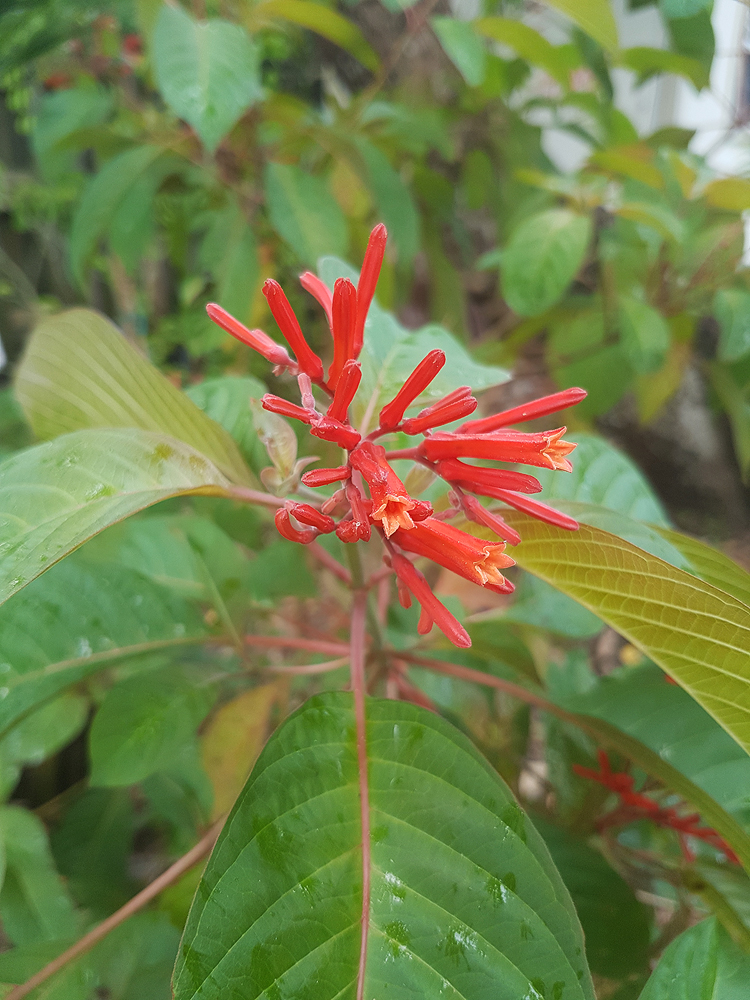
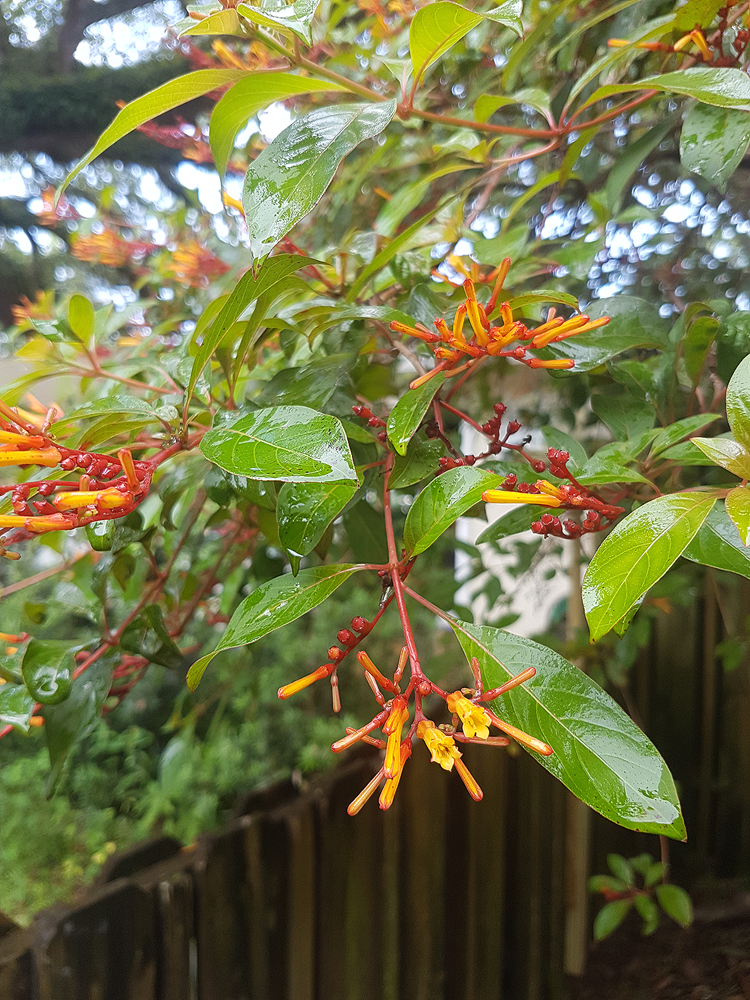
There are two types of Firebush: normal Firebush (Hamelia patens) and Dwarf Firebush (Hamelia patens var. glabra). From the best I can tell, only the normal Firebush is native to South Florida. The dwarf version isn’t simply a stunted version of the normal version, it’s a naturally occurring variety. It’s native to Mexico, through Central America and into South America, but not South Florida. Glabra tends to have yellower flowers, and the native variety tends to have redder flowers. But because both have a range of colors, and since the sizes overlap too, neither of these methods is a reliable way to tell them apart. The most reliable way is to inspect the underside of the leaves. The native variety is a bit fuzzy, while the glabra variety is smoother.
Here’s two great sites to learn more: “The Hamelia Mess” and Firebush at UFL IFAS